
Sorry, but your login has failed. Please recheck your login information and resubmit. If your subscription has expired, renew here.
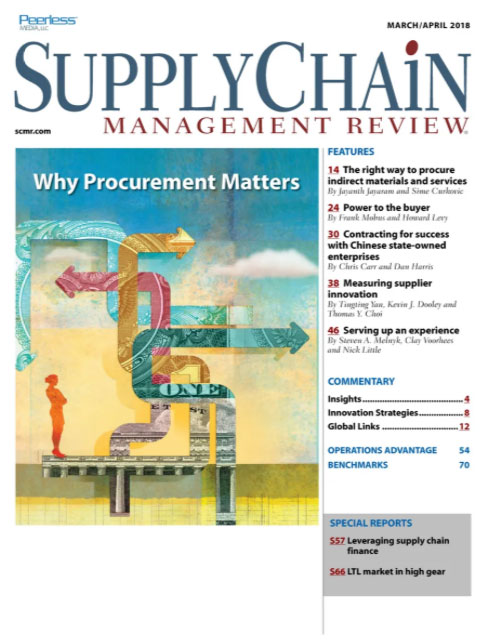
March-April 2018
"Inflation creeps into U.S. Supply Chain.” So said the headline on a Wall Street Journal article I read this morning before writing this column. The Journal went on to write that U.S. companies are grappling with rising material and ingredient costs on top of pressure from higher wages—a potential double whammy— and noted that companies like Whirlpool and Ford have already issued warnings to the market. Browse this issue archive.Need Help? Contact customer service 1-508-503-1313 More options
In 2016, Chevrolet’s all electric Bolt was named Motor Trend’s Car of the Year, thanks in part to delivering the most miles per charge for any electric vehicle then on the market. The award was as much a testament to GM’s newfound ability to access the innovation of its supply community as to its internal engineering prowess. In fact, GM noted in SCMR that gaining access to supplier innovation—like the propulsion technology from LG Electronics—was key to its competitiveness in the marketplace and the health of its balance sheet.
Automotive is not the only industry to benefit from supplier innovation. Pharmaceutical companies now investigate far more possible molecular designs because of innovations by analytical software providers, while farmers irrigate their land more precisely because of innovations by soil modelers. Even innovation giants like Google and Microsoft scan the landscape of tech start-ups to license or acquire intellectual property created outside of their company. Their chief procurement officers understand that the next big idea is being invented now, somewhere outside their company. Who is going to find it first: you or your competitors?
The answer is a mixed bag, based on the results of a recently completed research project on measuring supplier innovation by CAPS Research, a joint venture between Arizona State University and the Institute of Supply Management. While over 90% of CPOs surveyed thought it was important to measure a supplier’s innovation performance, only 25% had a system in place to do so (see sidebar: About our research).

This complete article is available to subscribers only.
Log in now for full access or start your PLUS+ subscription for instant access.
SC
MR
Sorry, but your login has failed. Please recheck your login information and resubmit. If your subscription has expired, renew here.
March-April 2018
"Inflation creeps into U.S. Supply Chain.” So said the headline on a Wall Street Journal article I read this morning before writing this column. The Journal went on to write that U.S. companies are grappling… Browse this issue archive. Access your online digital edition. Download a PDF file of the March-April 2018 issue.In 2016, Chevrolet's all electric Bolt was named Motor Trend's Car of the Year, thanks in part to delivering the most miles per charge for any electric vehicle then on the market. The award was as much a testament to GM's newfound ability to access the innovation of its supply community as to its internal engineering prowess. In fact, GM noted in SCMR that gaining access to supplier innovation—like the propulsion technology from LG Electronics—was key to its competitiveness in the marketplace and the health of its balance sheet.
Automotive is not the only industry to benefit from supplier innovation. Pharmaceutical companies now investigate far more possible molecular designs because of innovations by analytical software providers, while farmers irrigate their land more precisely because of innovations by soil modelers. Even innovation giants like Google and Microsoft scan the landscape of tech start-ups to license or acquire intellectual property created outside of their company. Their chief procurement officers understand that the next big idea is being invented now, somewhere outside their company. Who is going to find it first: you or your competitors?
The answer is a mixed bag, based on the results of a recently completed research project on measuring supplier innovation by CAPS Research, a joint venture between Arizona State University and the Institute of Supply Management. While over 90% of CPOs surveyed thought it was important to measure a supplier's innovation performance, only 25% had a system in place to do so (see sidebar: About our research).
SC
MR


Latest Supply Chain News
- What options do you really have? Shaping the supply chain resilience funnel
- Nexus suppliers: Hidden anchors of resilience in decentralized supply chains
- Developing the next generation of supply chain leaders: Is higher education serving the needs of the marketplace?
- The value proposition: Bridging the skills gap between the SCM degree and the workplace
- Lead time economics: What semiconductor supply chains reveal about strategic planning
- More News
Latest Podcast

 Explore
Procurement & Sourcing News
- When component verification becomes operational
- Caught between a rock and a hard place: Mapping your supply chain
- What options do you really have? Shaping the supply chain resilience funnel
- Nexus suppliers: Hidden anchors of resilience in decentralized supply chains
- Lead time economics: What semiconductor supply chains reveal about strategic planning
- Risk sharing is the new advantage in capital project delivery
- More Procurement & Sourcing
Latest Procurement & Sourcing Resources
Subscribe

Supply Chain Management Review delivers the best industry content.

Editors’ Picks



